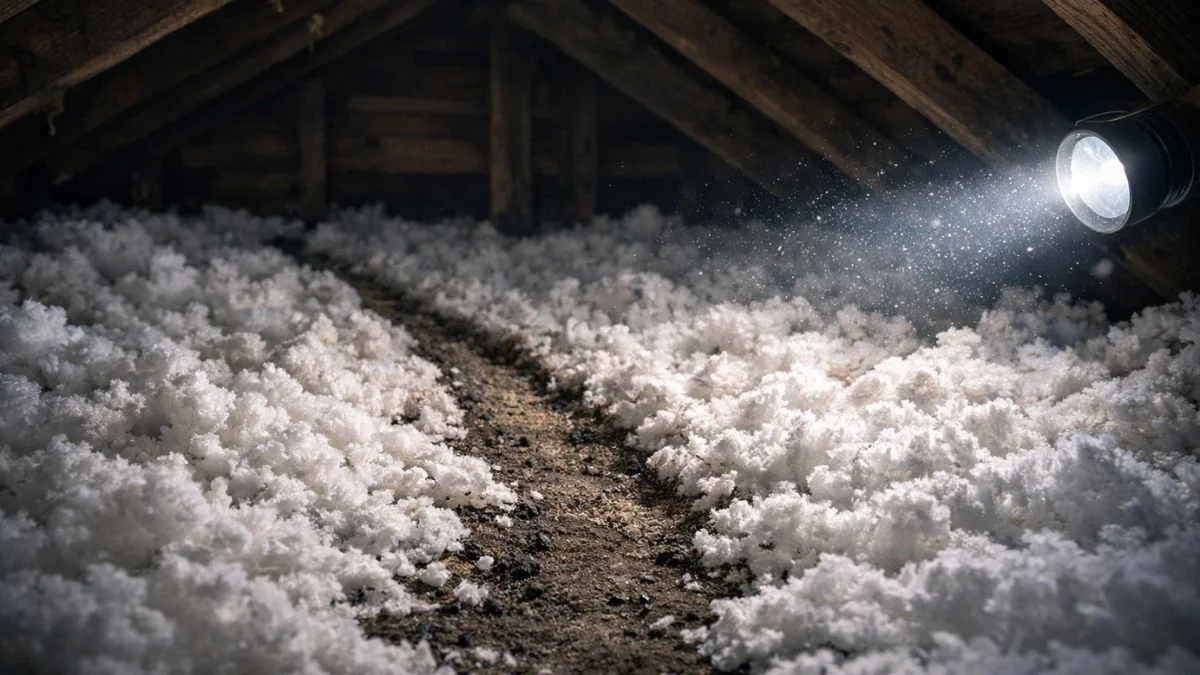
Sign 1: Overhead Scratching and Running Sounds After Dark
The most common first sign of attic rat activity is sound. Roof rats and Norway rats (in ceiling-level wall cavities) produce distinctive overhead scratching, running, and occasional thumping sounds. The timing is important for species confirmation:
- Roof rats: Most active from roughly 30 minutes after sunset through the middle of the night. If you hear sounds specifically after dark and they stop before dawn, roof rats are the most likely explanation.
- Squirrels: Active during daylight hours. If the sounds are loudest in the morning and early afternoon and stop at dusk, squirrels are the more likely explanation, not rats.
- HVAC systems: Ductwork expansion and contraction produces irregular metallic sounds typically associated with temperature change events (when the system starts and stops). Rat sounds are biological: irregular, varied in intensity, and distinctly movement-like rather than mechanical.
In Fayetteville, the attic-active species is almost always a roof rat (Rattus rattus) when activity is in canopy-heavy neighborhoods like Haymount, Massey Hill, Vanstory Hills, or Pine Forest. Norway rats rarely access attic spaces. they're ground-level burrowers.
Sign 2: Spindle-Shaped Droppings in Attic Insulation
Roof rat droppings are the most definitive confirmation of attic rat activity. Specific characteristics:
- Shape: Spindle-shaped, pointed at both ends. This distinguishes them from Norway rat droppings (capsule-shaped, blunt ends) and house mouse droppings (rod-shaped, very small).
- Size: Approximately ½ inch long. Norway rat droppings are ¾ inch. House mouse droppings are ¼ inch.
- Location: Concentrated near nesting areas in the insulation, along joists and rafters where rats travel, and near eave vents or gable vent openings where they enter and exit.
- Fresh vs. old: Fresh droppings are dark and moist-looking. Old droppings are grey, dry, and crumble when touched. A mix of fresh and old droppings indicates ongoing activity; only old droppings may indicate a resolved or dormant infestation.
Safety note: Rodent droppings carry disease risk. don't handle droppings without gloves, and don't vacuum or sweep dry droppings, this aerosolizes particles. Proper cleanup requires PPE and appropriate disinfectant application before removal.
Sign 3: Gnaw Marks on Attic Joists, Wiring, and Ductwork
Rats gnaw continuously. It's a biological necessity to wear down their constantly growing incisors. In attic spaces, gnaw marks appear on:
- Wood joists and rafters (bright, fresh wood exposed where bark or weathered surface has been removed)
- Electrical wiring insulation (the most serious finding, gnawed wiring creates fire risk and isn't cosmetic damage)
- HVAC ductwork and flex duct (entry into duct systems distributes allergens and particulates through the conditioned space)
- Stored cardboard boxes and insulation materials
Fresh gnaw marks have bright, clean wood or exposed material and pale wood edges. Older gnaw marks are darkened by oxidation and dust accumulation. Fresh marks confirm ongoing activity.
Sign 4: Grease Marks Along Joists and Rafters
Rats have oily fur. They travel the same routes repeatedly, and over time the oil from their fur transfers to the surfaces they contact: creating dark, greasy smear marks along the edges of joists, rafters, and beams where they run. These marks are called grease marks or rub marks.
Fresh grease marks have a slightly wet or glossy look. Older marks are flat, dry, and dark. The presence of grease marks establishes that the route has been used repeatedly and confirms an established colony rather than a single transient animal.
Sign 5: Disturbed or Compressed Insulation in a Localized Area
Roof rats nest in attic insulation (see our attic cleanup guide). A nesting area appears as a flattened, compressed zone within the insulation material, often with a visible central depression and surrounding disturbed material. Nesting areas may also contain shredded material: insulation fibers, paper, fabric threads, that the rats have gathered and incorporated into the nest structure.
Nesting areas are located near the entry point (eave vent or gable vent) but not immediately at the opening, rats prefer protected, interior locations within the insulation field rather than exposed positions near the entry.
Sign 6: Smell. Musty Ammonia Odor From Urine
An established rat colony in an attic produces a distinctive musty, ammonia-tinged odor from accumulated urine. This odor may be first noticeable in upper-floor rooms or near attic access hatches before it becomes apparent in the attic itself. The intensity correlates roughly with colony size and the duration of the infestation.
A strong odor from an attic space that has no obvious source: no plumbing, no stored materials, no condensation issues, is a strong indicator of rodent activity and warrants immediate attic inspection.
Sign 7: Visible Entry Points at the Roofline
This sign requires exterior inspection, which can often be done from the ground with binoculars or from a ladder at the eave level. Entry-point indicators visible from outside:
- Dark staining or grease marks around eave vent openings. The same oil transfer that creates grease marks inside creates entry-point staining outside
- Damaged, bent, or missing vent screen material at eave or gable vents
- Gaps at soffit-to-fascia junctions where wood has pulled away or softened
- Disturbed or removed roofing material at low-pitch roof edges near trees
What to Do After Confirming Attic Rat Activity
The correct response sequence is: (1) confirm species by signs, (2) identify entry points before beginning treatment, (3) develop a written plan covering both population removal and entry-point exclusion, (4) execute removal, then (5) seal entry points after the active population is eliminated.
don't seal entry points while the population is active inside, this traps rats in the living space where they may die in inaccessible wall cavities. Population removal comes first; exclusion comes after confirmation that the active infestation is resolved.
Call (844) 635-0403 for same-day attic inspection across Fayetteville and Cumberland County. We identify species, map entry points, and provide a written treatment plan before any work begins.